LED tunnel light: one bore, two lighting problems
At the portal the eye is adapting from daylight to a dark bore, and the lighting has to manage that adaptation. Inside, the eye is settled and the job is evenness, maintenance and dust. The two zones want different fixtures and different controls.
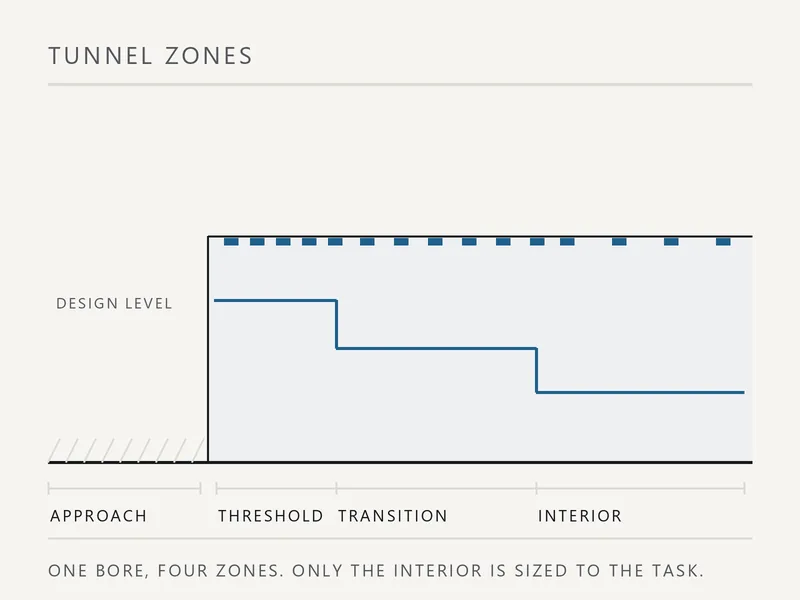
The client's catalogue does not cover tunnels, so this card is a drawing of the zones rather than a photograph of a product. The line pages carry the design method.
Builds in this line (2)
The two zones worth a page
The threshold zone is designed against the approach luminance, which changes with the weather and the speed limit. The interior zone is designed against the task. Both are in the same bore and neither can be specified without the other.
Zone against design driver
A tunnel is the one space on this site where the design is governed by an external luminance the lighting designer does not control.
| Zone | Design driver | Optic | What decides it |
|---|---|---|---|
| Threshold | Approach luminance and adaptation | Asymmetric, aimed down the bore | Portal orientation and the speed limit |
| Transition | The step down from threshold | Stepped levels along the bore | Length of the zone and the traffic |
| Interior | Task and evenness on the road surface | Symmetric or wide asymmetric | Bore geometry and the wall finish |
| Exit | Adaptation back to daylight | Symmetrical, often dimmed | The view out and the time of day |
The threshold luminance is measured outside, on the approach, over a defined field of view. A portal facing east is a different design from an identical portal facing north, which is why a tunnel fixture cannot be sold on a catalogue page alone.
Why the portal is the hard part
A driver approaching a tunnel sees a bright surround and a dark hole. The eye adapts to the bright surround, so the bore appears black, and the lighting has to lift the road surface at the entrance to a level the adapted eye can use. That level is a multiple of the interior level, which is why the threshold run is the most heavily loaded part of the installation.
The consequence is a control problem as much as a lighting problem. The threshold level has to follow the outside luminance through the day, or the installation is either wasteful at night or unsafe at noon. That is why tunnel schemes are specified with a dimming curve and a luminance sensor, not just a fixture.
- Threshold zone
- The run at the portal, loaded to match the approach
- Transition zone
- A stepped reduction after the threshold
- Interior zone
- The settled middle, designed to the task
- Exit zone
- Adaptation back to daylight
- L20
- The luminance method used to set the threshold
- Access
- Partial or full closure, and the maintenance window
- Control
- Luminance sensor and dimming curve
- Wash down
- Dust, exhaust and the cleaning regime
What a tunnel enquiry has to carry
A fixture cannot be selected from a bore diameter alone.
- The portal orientation and the approach, because the threshold level is derived from the luminance in front of it.
- The speed limit and the traffic mix, which set the adaptation time and therefore the length of each zone.
- The bore geometry: width, height, wall finish and the mounting height available for the luminaire line.
- The maintenance regime: partial closure, a rolling lane, or a full night stop. It sets how accessible a driver has to be.
A tunnel luminaire is usually chosen for its photometry first and its housing second. The housing matters for dust and wash down, but a scheme with the wrong distribution cannot be corrected by a better gasket.
Dust, exhaust and the maintenance factor
A tunnel is a dirty environment with a high utilisation. The maintenance factor in the design assumes a cleaning cycle, and that cycle is the difference between a scheme that holds its level and one that visibly decays.
- Ask for the maintenance factor the design assumes, and the cleaning interval behind it.
- Ask what the optical compartment is sealed against, and how the seal is replaced.
- Ask for the driver position, because a driver at the top of a bore is a closure and one at the side is a lane.
- Housing
- Corrosion class and wash down rating
- Sealing
- Gasket type and replacement part
- Driver
- Position, access and replaceability
- Control
- Sensor interface and dimming protocol
Before the order
Four things a tunnel project will ask for that a catalogue page never carries.
- The lighting calculation per zone, at the maintenance factor in the contract.
- The dimming curve and the sensor interface, agreed with the control contractor.
- The maintenance access plan, including how a luminaire is removed.
- The corrosion and wash down specification, which is usually a project standard.
- Zones
- Threshold, transition, interior, exit
- Optics
- Asymmetric, symmetric, wide
- Control
- Luminance sensor, dimming profile
- Ask for
- Calculation, IES file, access plan
Send the space, the standard and the mount.
What is being lit, to what requirement, mounted where, and what power is available is enough. The reply is a build, a specification sheet and the option list for each line item.