LED stadium light: the mount decides the beam
A stadium is not lit by a fixture, it is lit by a plan: where the masts stand, how high they are, and how many aiming points each one carries. The fixture is chosen last, after the geometry.
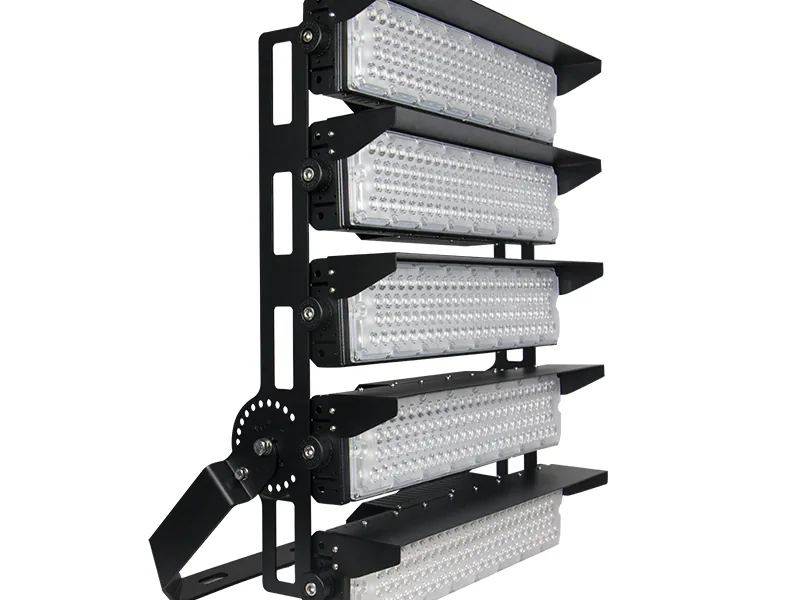
A stadium scheme is a set of aiming points. The heads are identical and the aim is not, which is why the aiming plan is part of the product rather than a note at the end.
Builds in this line (3)
Three ways to mount a stadium light
The same photometric problem, solved from a 30 m column, from a modular frame at 15 m, or from a club pitch with four corner poles. Pick the mount, then the optics.
Mount against site
The mount is a civil decision before it is a lighting decision. It sets the aiming angle, the maintenance access and the spill light that leaves the site.
| Mount | Typical site | Aiming | What it decides |
|---|---|---|---|
| High mast on a column | Stadium, port, rail yard | Aimed down from above the roof line | Spill control and the maintenance lift |
| Modular frame at mid height | Training ground, club pitch, school | Aimed across the pitch from the sides | The frame and the ballast plan |
| Corner poles | Small pitch, court, multi use area | Cross aimed from four corners | Pole height against pole setback |
A luminaire aimed across a pitch throws light into the sky behind it. A luminaire aimed down from a tall mast does not, which is why a residential boundary usually forces the taller, more expensive option.
What the standard actually fixes
Sports lighting is bought against a class, not against a wattage. The class sets the maintained illuminance on the playing surface, the uniformity ratio beside it, and the glare rating a player or a camera is allowed to see. Raise the class and every number in the design moves at once: more luminaires, tighter aiming, taller masts.
Uniformity is the number that separates a usable pitch from a bright one. A surface lit at an average level with dark bands between the aiming points reads as patchy to a player tracking a ball, and as banding to a camera. The average can be correct and the pitch still unusable, which is why the ratio is specified beside the level rather than after it.
- Design standard
- EN 12193 for sports lighting, class agreed with the client
- Level
- Maintained illuminance on the playing surface, per class
- Uniformity
- Minimum over average, and minimum over maximum
- Glare
- Glare rating limit, aimed away from the main viewing direction
- Colour
- CRI and colour temperature, raised for broadcast
- Flicker
- Flicker free driver where super slow motion is specified
- Mount
- Mast height, setback, and the aiming plan per pole
- Maintenance
- How a luminaire is reached and re-aimed
Which build for which site
The short version, before the specification table on each build page.
- A stadium or a show court: high mast on columns, aimed down, with the aiming plan drawn before the columns are poured. This is the only arrangement that keeps spill light inside the site boundary.
- A training ground or a club pitch: a modular frame at mid height. It is cheaper to erect and cheaper to re-aim when the pitch is resurfaced, at the cost of a wider spill footprint.
- A school, a court or a multi use area: corner poles. The geometry is fixed by the fence, so the design works backwards from the pole positions the site will allow.
- Broadcast: ask for the flicker figure and the colour rendering first. A pitch that looks correct to the eye can still band on camera.
None of these choices depends on the fixture wattage. Ask for the class, the surface size and the mast positions, and the fixture follows. A supplier who quotes a wattage before those three is quoting a catalogue, not a design.
What to put in the enquiry
A stadium enquiry that arrives with the surface dimensions, the class and the mast positions can be answered with a layout. One that arrives with a wattage can only be answered with a price.
- The playing surface and the run off area, in metres.
- The class, or what the site is used for and who watches it.
- Mast or pole positions that exist, or the boundary they have to sit inside.
- Whether the site is broadcast, and at what level.
- The supply available at each mast, and who provides the columns.
- Reply includes
- Layout, aiming plan, luminaire schedule
- Ask for
- Photometric file, aiming chart, wind load data
- Not published here
- Wattage, lumens, efficacy
- Confirmed per project
- Level, uniformity, class, optics
Before the order
Four items that are cheap to settle on paper and expensive to settle on site.
- The aiming plan, signed off by whoever owns the pitch. Re-aiming after the columns are up is a lift hire, not an adjustment.
- The maintenance position: a luminaire that cannot be reached safely will not be re-aimed, and the design decays from the first season.
- Spill light at the boundary: check it against the local rule before the column height is fixed, because the height is what usually conflicts.
- The optics list: a stadium mixes narrow and wide units. Ask which optic goes where, not just how many.
- Mounts
- High mast, modular frame, corner poles
- Optics
- Narrow, medium, asymmetric
- Control
- Contactors, dimming by scene
- Ask for
- Layout, aiming plan, photometric files
Send the space, the standard and the mount.
What is being lit, to what requirement, mounted where, and what power is available is enough. The reply is a build, a specification sheet and the option list for each line item.