LED street light: the road class sets the requirement
Road lighting is specified by class, and the class is chosen by the road, the traffic and the people on it. Once the class is fixed, the mounting height and the distribution follow, and the fixture is the last decision.
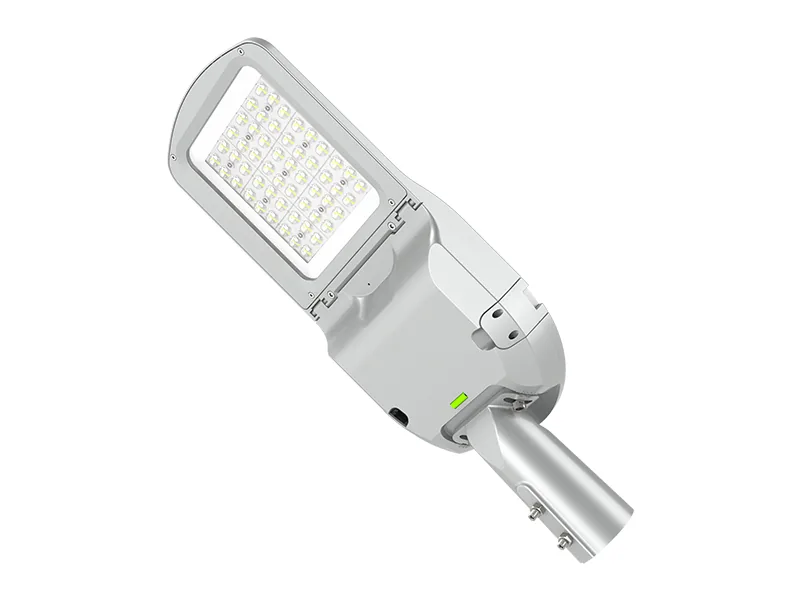
A road luminaire is evaluated on a calculation and installed on a pole. The spigot, the overhang and the tilt are as much part of the product as the optics.
Builds in this line (2)
A road and a path are different jobs
One is designed for a driver at speed, the other for a person on foot at close range. The two builds take the class and the distribution for each.
Road class against mounting
Height and spacing are a pair. Raising the mounting height without widening the spacing buys uniformity and costs poles, which is why the pair is fixed together in a design.
| Road type | Class driver | Mounting | What decides it |
|---|---|---|---|
| Municipal distributor road | Traffic speed and volume | Pole at carriageway edge | Carriageway width and the class |
| Residential street | Pedestrians and parked cars | Lower poles, closer spacing | Tree canopy and driveways |
| Park path or footway | Pedestrian comfort and safety | Low pole or bollard | Sight lines and the canopy |
| Car park | Faces, bays and circulation | Perimeter or island poles | Bay layout and CCTV coverage |
A street light is judged from a moving vehicle and from a doorway at the same time. The class deals with the first; the second is about glare into windows and is usually settled by the optic and the aiming, not by the level.
Class, distribution, then fixture
A road class fixes the average luminance or illuminance on the carriageway, the uniformity over it, and the glare it may present to a driver. The distribution then has to put light where those numbers are measured, which is not the same as putting it where the pole happens to stand.
This is why street lighting tenders ask for a lighting calculation rather than a luminaire. The calculation is the product: pole positions, mounting heights, overhang, tilt and distribution, with the class achieved at the maintenance factor the client specifies.
- Class
- Set by road type, traffic and conflict areas
- Distribution
- Short, medium or long, and symmetric or not
- Overhang
- How far the luminaire reaches over the carriageway
- Tilt
- Aim, which trades uniformity against glare
- Maintenance factor
- The depreciation the design has to survive
- Cut off
- Back light and up light control
- Control
- Dimming profile, often part of the tender
- Mounting
- Side entry, post top, wall or suspension
What a tender actually asks for
The checklist that decides whether a bid is compliant.
- The lighting calculation, to the specified class and maintenance factor, for the actual pole layout.
- The photometric file for the exact model and optic, not a family average.
- The photometric and electrical data sheet, with the model code that will be delivered.
- Certification for the destination market, with the scope of the certificate and the models it covers.
- The control and dimming interface, where the scheme has one.
A certificate belongs to a company and a model. Ask for the file that names the model being supplied, and check its scope and expiry date rather than the logo on a page.
Maintenance is half the cost
A road scheme is judged over fifteen years, not over the first night. What decides that is access: whether a luminaire can be reached by a standard lift, whether the driver is replaceable in the field, and whether the same model will still be available in year eight.
- Ask how a driver or a module is replaced, and whether it needs the whole head off.
- Ask for the surge protection class, because a road pole is a lightning target.
- Ask what the sealed optical compartment is rated to, and against what test.
- Ask for the spares policy in writing, including the minimum order for a spare.
- Design life
- Set by the client, not by the catalogue
- Access
- Lift, ladder or platform, and the pole height
- Replaceable
- Driver, module, lens, gasket
- Surge
- Class agreed with the site
- Warranty
- Terms, and who pays freight on a claim
Before the order
Four items that separate a compliant bid from a cheap one.
- The class and the maintenance factor in writing. A calculation at a lower maintenance factor is not the same product.
- The pole interface: spigot diameter, entry type, and the tilt the bracket allows.
- Back light and up light limits, which are a planning condition in many jurisdictions and a specification item in most tenders.
- The delivered model code, so the data sheet and the carton match.
- Roads
- Municipal, residential, car park
- Paths
- Footway, cycle path, park
- Mounting
- Side entry, post top, wall, suspension
- Ask for
- Calculation, IES file, certificate scope
Send the space, the standard and the mount.
What is being lit, to what requirement, mounted where, and what power is available is enough. The reply is a build, a specification sheet and the option list for each line item.