Stadium lighting: why uniformity matters more than lumens
A pitch can hit its average level and still be unusable. The number that decides whether players and cameras can work is the ratio between the darkest point and the average, not the total output.
Two numbers that mean different things
Stadium lighting is specified with a level and a uniformity. The level is an average on the playing surface, usually a maintained value that the design has to hold as the installation ages. The uniformity is the relationship between that average and the darkest point in the measured grid.
The two are independent. A surface can be lit to a comfortable average with dark bands between the aiming points, and read as patchy to anyone moving across it. Raising the output raises both the average and the bands, so a brighter installation with the same geometry has the same problem, at a higher running cost.
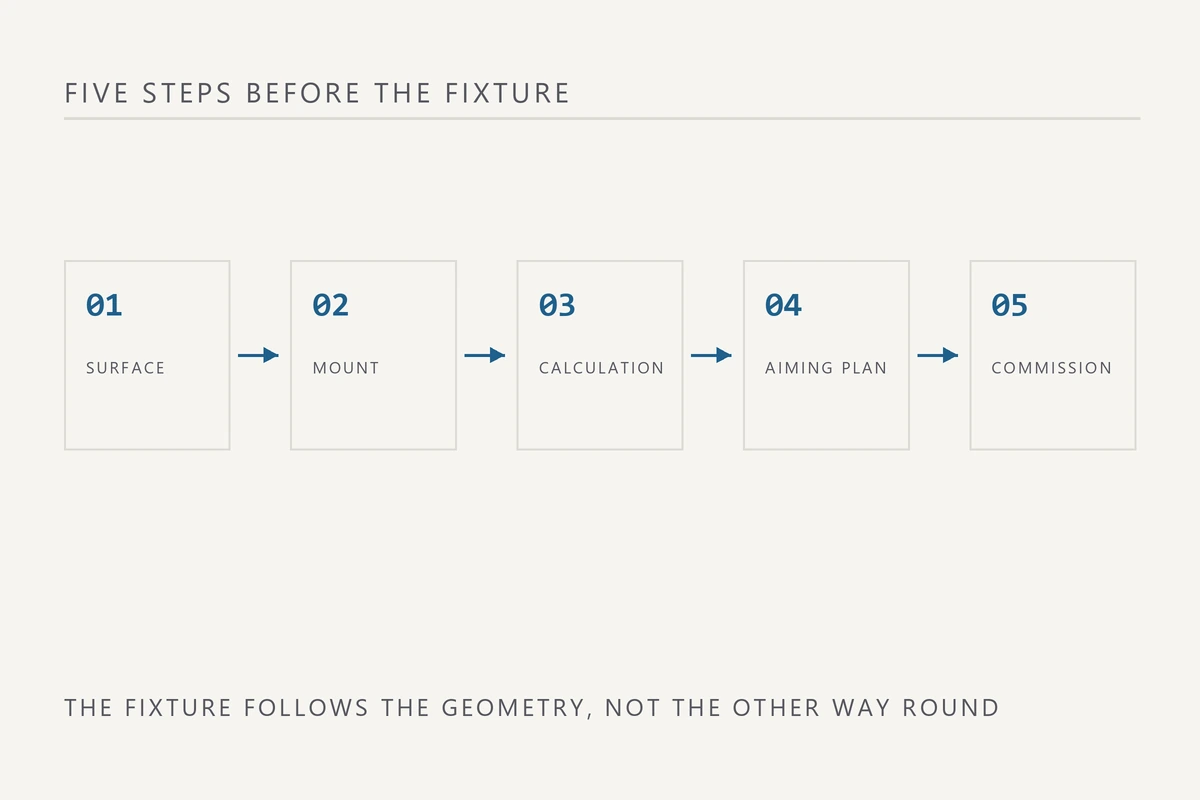
Where uniformity actually comes from
From overlap. Each luminaire covers a patch, and the patches have to overlap enough that no point on the surface is covered once and its neighbour twice. The variables are the mounting height, the spacing between aiming points, the beam angle and the aiming direction. Change one and the ratio moves.
This is why the same four floodlights can light one ground well and another badly. On a wide pitch the beams cross at shallow angles, the corners fall off, and the only corrections are taller masts, more aiming points or a different beam. None of those is a bigger fixture.
| Question | What it tells you | Where it comes from |
|---|---|---|
| What is the level? | The average the design holds | The class agreed with the client |
| What is the uniformity? | How even it is, darkest against average | The same class, and the calculation |
| What is the glare rating? | How much a player or camera is dazzled | The photometric file, per aiming direction |
| What is the colour rendering? | Whether colour reads correctly | The lamp, raised for broadcast |
| Is there a flicker figure? | Whether a camera bands | The driver, not the fixture body |
Glare is a direction, not a property
A floodlight is comfortable from one side and blinding from another. The glare rating in a sports design therefore belongs to the aiming direction and the viewing position, not to the fixture on its own. Two schemes using identical units can have very different ratings depending on where the masts stand.
That is also why spill light and glare are related but not the same. Spill is light that leaves the site and lands on a neighbour. Glare is light that enters an eye inside the site. Aiming down from a tall mast reduces the first and can worsen the second if the viewing position is under the mast.
Colour and flicker, for the camera
A surface that looks correct to the eye can band on camera. Broadcast work raises the colour rendering requirement, adds a colour temperature consistency requirement across batches, and adds a flicker requirement because a camera sampling at a high frame rate sees the driver switching that the eye averages out.
If a venue might ever be filmed, ask for those figures at the design stage. A driver family chosen for a pitch is difficult and expensive to change after the masts are up, and it is a line on a data sheet rather than something that can be tuned on site.
What to ask for, in order
- The class and the calculation, at the maintenance factor in the contract.
- The aiming plan, one target per luminaire, with the beam for each.
- The photometric file for the exact optic, not a family average.
- The glare rating for the actual viewing directions.
- The flicker and colour figures, if the venue is or may be filmed.
- The access plan, because a scheme that cannot be re-aimed decays.
A design that starts from a fixture and works back to a class is a sales document. A design that starts from the surface, the class and the mast positions is a scheme, and it can be checked by anyone with the calculation and the photometric files.
Updated 2026-10-22 · 3 min read. Standards and product data change without notice; confirm the current edition and the current sheet before you publish a claim or write a tender document.
Questions that come back
Short answers, before the email.
Is uniformity the same as evenness?
Practically, yes. It is stated as a ratio between the darkest measured point and the average, and sometimes as darkest against brightest. The two are not interchangeable, so a specification should say which one it means.
Can I fix a patchy pitch by adding fixtures?
Sometimes, if the geometry has room for another aiming point. Often the cheaper fix is to re-aim what is there, or to widen the beam on the units covering the dark areas. Adding output in the wrong place raises the average and leaves the bands.
Does a higher class always mean more fixtures?
Not necessarily more fixtures, but always a tighter design. A higher class raises the level and tightens the uniformity at the same time, which usually means taller masts or more aiming points rather than larger units.
Send the space, get the configuration.
Build, calculation offer and the specification sheet for each line item, in one reply.