High bay retrofit: how to calculate the payback before you quote
A payback figure is arithmetic, and the arithmetic is simple. What makes retrofit quotes disagree is not the formula, it is which numbers were put into it, and whether anyone measured before the old fixtures came down.
The formula, written out
Annual energy saving in kilowatt hours is the difference between the old load and the new load, multiplied by the hours the installation runs in a year. Annual cost saving is that figure multiplied by the tariff the site actually pays. Payback in years is the installed cost divided by the annual cost saving.
| Input | Where it comes from | How it goes wrong |
|---|---|---|
| Old load | Measured or read from the existing fittings | Taken from a catalogue instead of the installation |
| New load | The proposed schedule, not one fixture | Quoted for the unit, not the design |
| Running hours | The site's own record, or the shift pattern | Assumed at 24 hours for a single shift hall |
| Tariff | The site's bill, including demand and standing charges | Taken as a headline energy rate only |
| Installed cost | Fixtures, fixings, labour, access, disposal | Quoted as the fixture price alone |
Why the simple version misleads
The simple version compares the old lamp rating with the new one. That ignores two things that change the answer: the old installation is probably running below its rated output, because the lamps have aged and the optics are dirty, and the new installation may be designed with fewer units because the distribution is better.
It also ignores the non energy savings, which on a high bay retrofit are often larger than the energy line. Lamp changes on a scissor lift, at height, out of hours, are a real annual cost. So is the labour spent re-lamping a hall that cannot be closed during production.
The inputs you must not guess
The old load has to be measured or read off the existing fittings, not assumed from a type. The running hours have to come from the site, because a single shift hall and a three shift hall produce payback figures that differ by a factor of three on identical hardware.
The tariff has to come from the bill, including the demand charge where the utility applies one, because a retrofit that reduces peak demand changes that line as well. And the installed cost has to include the access equipment and the disposal of the old units, which on a tall hall are not small.
- Measure before you remove anything. A baseline taken afterwards is a memory, not a measurement.
- Count the fittings, and note their condition. A dirty optic is part of why the hall feels dark.
- Ask for the shift pattern, not the opening hours. The two differ by the cleaning and the maintenance windows.
- Read the bill. The energy rate is one line of it.
- Price the install. Fixings, access, labour and disposal are part of the number the client signs.
What to put in the quotation
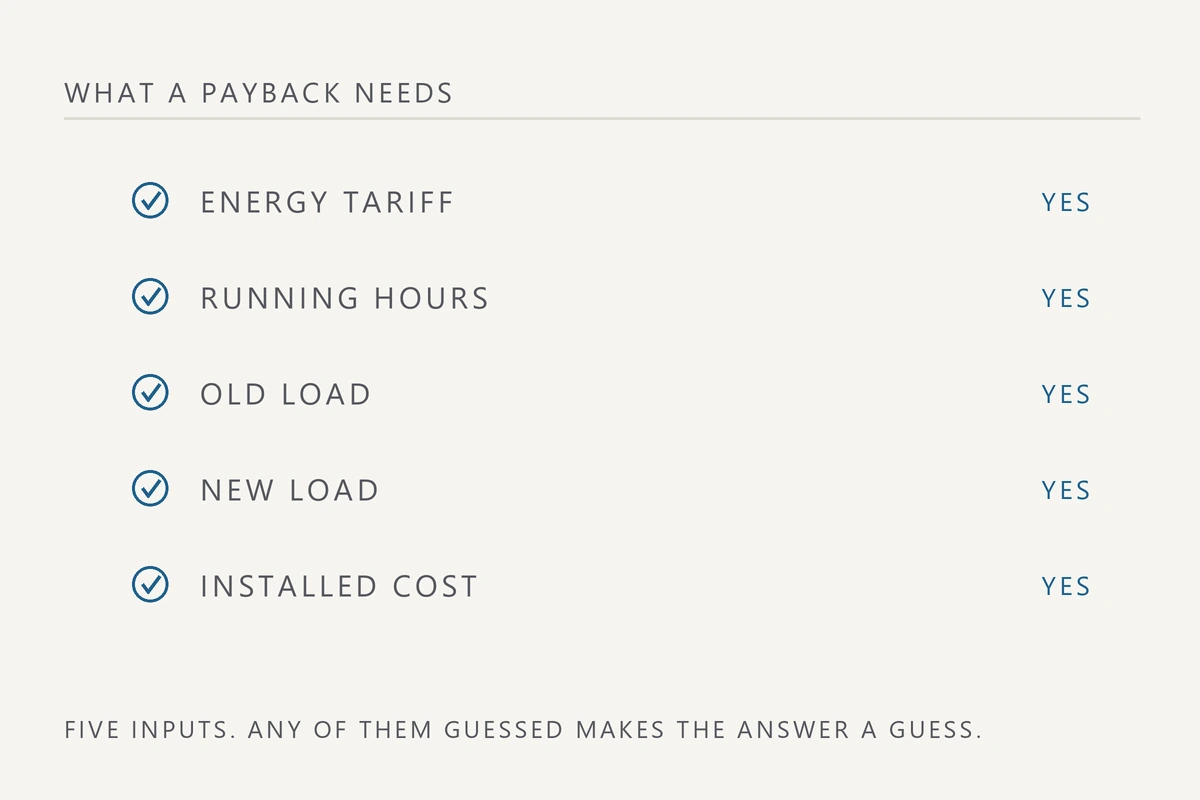
Put the five inputs in the quote, with the source for each. A client who can see where the numbers came from can check them, and a competitor who cannot show the same is at a disadvantage that has nothing to do with price.
Then state the design assumption that the saving depends on: the hours, the tariff and the maintenance interval. If the site runs longer hours than assumed, the payback improves; if it runs fewer, it lengthens. Saying so protects the quote and is more convincing than a single confident number.
This page gives the structure of the calculation and nothing else. The tariff, the hours and the installed cost are the buyer's numbers, and filling them in with a guess is how a payback claim becomes a dispute.
Updated 2026-10-22 · 3 min read. Standards and product data change without notice; confirm the current edition and the current sheet before you publish a claim or write a tender document.
Questions that come back
Short answers, before the email.
What is a good payback period?
It depends on the client's cost of capital and on the life of the building, so there is no universal answer. What matters is that the figure is built from measured inputs and that the assumptions are written down beside it.
Should maintenance savings be in the payback?
They should be shown separately rather than folded into the energy line, because they depend on access and on the site's own labour rate. A quote that separates them is easier to defend when the client's finance team asks.
Does a retrofit always need a new design?
Not always. Keeping the existing rows and fixing points is usually the cheapest option, and it is worth modelling before re-planning. Re-planning costs more in labour than in hardware, so it needs a photometric case rather than a preference.
Send the space, get the configuration.
Build, calculation offer and the specification sheet for each line item, in one reply.